
CE marking or “China Export”: how to check?
A CE logo with the letters too close together circulates on products made in China under the name “China Export”. The real question is not the logo’s design, but the proof of conformity behind it.
There is no official “China Export” mark: a CE logo with squeezed letters is a badly reproduced or misleading CE marking. All that counts is a CE marking with the regulatory proportions, backed by an EU declaration of conformity and technical documentation the importer must be able to present for ten years.
Two almost identical logos
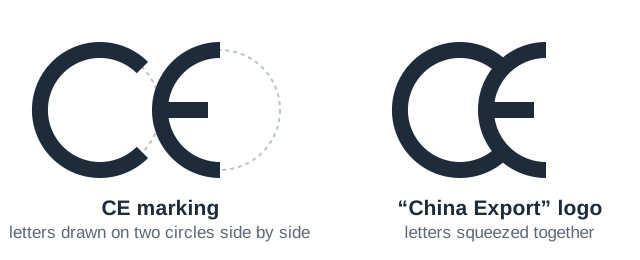
The CE marking has a design fixed by EU legislation (Regulation (EC) No 765/2008 and Decision No 768/2008/EC, Annex II): each letter is drawn on a circle of the same diameter, and the two circles sit side by side, leaving a clearly visible space between the C and the E. The logo can be enlarged or reduced, but these proportions must be respected, and it must be at least 5 mm high unless the applicable legislation provides otherwise.
The so-called “China Export” logo takes the two letters and moves them closer together. It is neither an official mark nor a Chinese certification: the European Commission has stated that it is not aware of any mark of that name. Whether it is a drawing error or an intent to mislead, the result for you is the same: the product does not bear a compliant CE marking.
What CE marking really means
CE marking is neither a quality label nor a certification issued by a body. It is the manufacturer’s declaration that the product meets all the European requirements that apply to it. It is only mandatory for products covered by legislation that provides for it, for example:
- toys (Directive 2009/48/EC, EN 71 standards);
- low-voltage electrical equipment and electromagnetic compatibility;
- personal protective equipment, machinery, radio equipment.
For most of these products, the manufacturer carries out the conformity assessment itself. For some, a notified body must be involved: its four-digit number then appears next to the CE logo and can be checked in the European Commission’s NANDO database. CE marking on a product that does not fall under such legislation is itself an infringement.
Checking the EU declaration of conformity
Ask the supplier for the EU declaration of conformity of the exact model you are buying. At a minimum, it must state:
- the identification of the product (model, reference, batch or serial number) so it can be traced;
- the name and address of the manufacturer, and a statement that the declaration is issued under its sole responsibility;
- the EU legislation applied (directives or regulations) and the harmonised standards used, with their dates;
- where applicable, the name and number of the notified body, and the certificate it issued;
- the place, date, name, function and signature of the signatory.
Be wary of a declaration that cites no standard, covers another model, refers to a withdrawn standard or is replaced by a laboratory “certificate”. Also ask for the test reports it relies on and check they cover your product, with its current materials and components. As the importer, you must keep this declaration available to the authorities for ten years and put your contact details on the product.
Checking before shipping
- Before the order: require in the purchase order a compliant CE marking, the EU declaration of conformity and the model’s test reports.
- During production: if in doubt about materials or components, have the tests done in a laboratory; only a test proves conformity to a standard.
- Before shipping: the final random inspection checks markings and labelling on the sample drawn: logo, contact details, warnings, instructions.
Non-compliant products often end up in Safety Gate, the European alert system for dangerous products. Our Safety Gate barometer shows, sector by sector, which products are taken off the market and for which risks. For the traceability required of the importer, see also our guide quality control and traceability.
Frequently asked questions
Can a product with the “China Export” logo be sold in Europe?
Not as it is if the product falls under legislation that requires CE marking (toys, electrical equipment, protective equipment…). The logo does not replace CE marking and may be considered misleading. Have the marking corrected before shipping, and only if the product genuinely complies, with evidence to back it up.
Is a “CE certificate” sent by the supplier enough?
No. A document titled “CE certificate” or “certificate of compliance” issued by a laboratory is not the EU declaration of conformity: it often covers another model or outdated standards. Ask for the manufacturer’s signed declaration and the test reports for the exact model, or have the product tested in a laboratory.
Who is responsible if the CE marking is false?
In the European Union, the importer must check, before placing the product on the market, that the manufacturer has carried out the conformity assessment, that the technical documentation exists and that the product bears the CE marking. Improper marking exposes you to a withdrawal from the market or a recall, at your expense.
Have conformity checked before shipping
Our inspectors check the markings on the lot, and our affiliated laboratories run the tests that prove conformity.