Free PDF
Pre-shipment inspection checklist
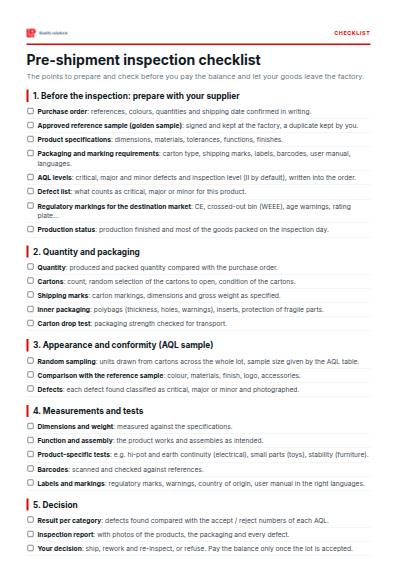
The points to prepare and check before you pay the balance: quantities, packing, workmanship, measurements and tests.
Download the PDF
Inspections, factory audits, AQL sampling and lab testing: everything an importer needs to secure products made in China and across Asia.
Buying from factories in China, Vietnam, India or Bangladesh gives you access to competitive prices and a huge manufacturing base. It also puts thousands of kilometres between you and your production. This guide explains, step by step, how importers control quality in Asia: which inspections to book and when, how AQL sampling works, how to assess a supplier before ordering, and which lab tests your products need to be sold legally in Europe. It is based on the work LPI Quality has carried out on the ground since 2012.
When you import into the EU, you are responsible for the product: if it is unsafe or non-compliant, the authorities can block it, pull it from shelves or order a recall at your cost. A defect caught at the factory costs a rework; found at destination, it costs the whole lot.
When you import a product into the European Union, you take responsibility for it on the European market. If it is unsafe or non-compliant, the authorities can block it at the border, withdraw it from shelves or order a recall from consumers, at your cost and in front of your customers. The EU General Product Safety Regulation also requires every lot to be identifiable: our guide quality control and traceability details what to document.
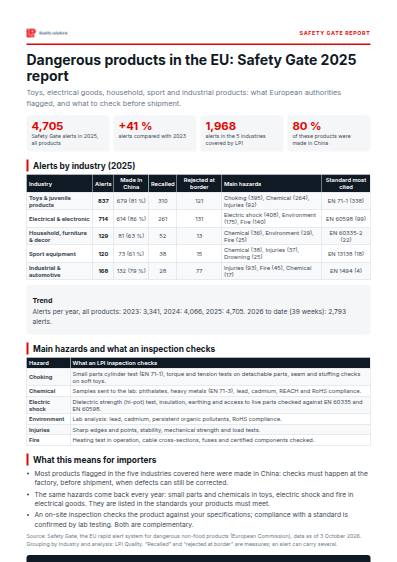
These figures come from Safety Gate, the EU rapid alert system for dangerous non-food products. Every alert is a product that reached Europe with a defect that a factory inspection or a lab test could have caught: small parts that detach from a toy, a charger that fails the dielectric strength test, a chair that tips over, a banned phthalate in a plastic. They are part of our Quality Observatory, alongside product recalls in France and imports from China, updated every week. For your own product, the Product Defects Monitor brings together the alerts and recalls of equivalent products and shows the defects that come back most often.
Distance is the other risk. The “sales manager” you met at a trade show or on an online platform is often not employed by the factory and has little control over production. Specifications get lost in translation, raw materials are changed to save costs, and problems are discovered only when the container is opened. A defect found at the factory costs a rework. The same defect found at destination costs the whole shipment.
Third-party quality control puts independent eyes in the factory, at the moments that matter. That is the job of LPI Quality. Should you rather inspect yourself or outsource? It depends on the product and how often you order. To compare providers, see how to choose an inspection company in China.
A production inspection plan has five stages: initial production check, during-production inspection, production monitoring, pre-shipment inspection and container loading check. Pre-shipment is the most common; the right mix depends on the product, the supplier’s track record and the shipment value.
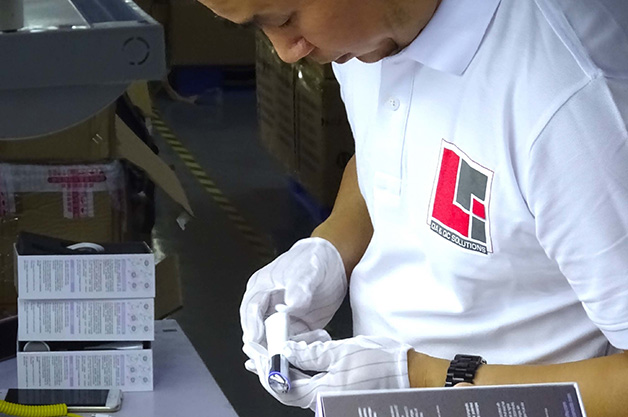
An inspection plan follows the life of your order. You do not need every stage on every order: the right mix depends on the product, the supplier’s track record and the value of the shipment. See all our inspection services.
For a new product, a first article inspection (FAI) can come before these five stages: the very first pieces from the series tooling are checked against the drawings and the approved sample before production starts.
Carried out when 1 to 20% of the goods have been produced. The inspector checks a sample of raw materials and components against the AQL standard, reviews the manufacturing process and the operators’ understanding of your requirements, and compares the first finished pieces with the approved master sample. It uncovers raw material issues and misunderstandings before they are repeated on thousands of units. Initial production check.
Also called inline inspection, it takes place while production is running. Defects are spotted in time for corrective actions, the inspector raises attention on sensitive points and checks whether the order is really on schedule for your shipping date. It is especially useful for large orders. During production inspection.
An inspector stays on the production line, picks products at the different stages, sorts out defective pieces and has them reworked to your requirements, with daily reporting. It is the right tool when a supplier has failed a previous inspection or when the product is critical. Production monitoring.
The most common inspection, carried out when production is finished and the goods are packed. A random sample is drawn according to the AQL standard and checked for quantity, workmanship, dimensions, functions, markings and packing, against your specifications and the approved sample. Defects are classified as critical, major or minor, and the report tells you whether the lot meets your AQL: you decide whether to ship the goods as they are, have them reworked or sorted. Final random inspection.
The inspector attends the loading: quantities, condition of the cartons and pallets, shipping marks, and a final check that the goods loaded match your specifications. Your products will travel for weeks; they must leave the factory well packed and safely loaded. Container loading supervision.
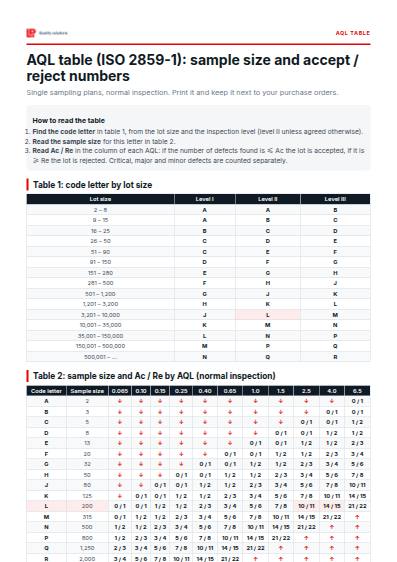
For a 5,000-piece lot at inspection level II, the inspector checks 200 pieces under AQL (ISO 2859-1). The lot is rejected at 1 critical defect, 11 major defects (AQL 2.5) or 15 minor defects (AQL 4.0).

Inspecting 100% of a production is rarely possible. Inspections therefore use the AQL (Acceptable Quality Level) sampling method defined by ISO 2859-1 (formerly MIL-STD-105E). It tells the inspector how many pieces to check and how many defects are acceptable, depending on three settings:
Example for an order of 5,000 pieces at inspection level II (code letter L):
| Type of defect | AQL | Sample size | Lot accepted with up to | Lot rejected from |
|---|---|---|---|---|
| Critical | 0 | 200 | 0 defects | 1 defect |
| Major | 2.5 | 200 | 10 defects | 11 defects |
| Minor | 4.0 | 200 | 14 defects | 15 defects |
Agree on the AQL levels with your factory before placing the order and write them into the purchase order: when an inspection fails, you can then legitimately ask the supplier to rework the goods and pay for the re-inspection. Our AQL calculator gives the sample size and limits for any order, our AQL guide explains inspection levels and the ANSI Z1.4 equivalent, and our glossary explains the vocabulary.
Before your first order, check that the supplier is a real manufacturer and can deliver: desk-based due diligence, an initial factory evaluation or a full technical audit, depending on the stakes. Social and environmental audits add to this for exposed brands.
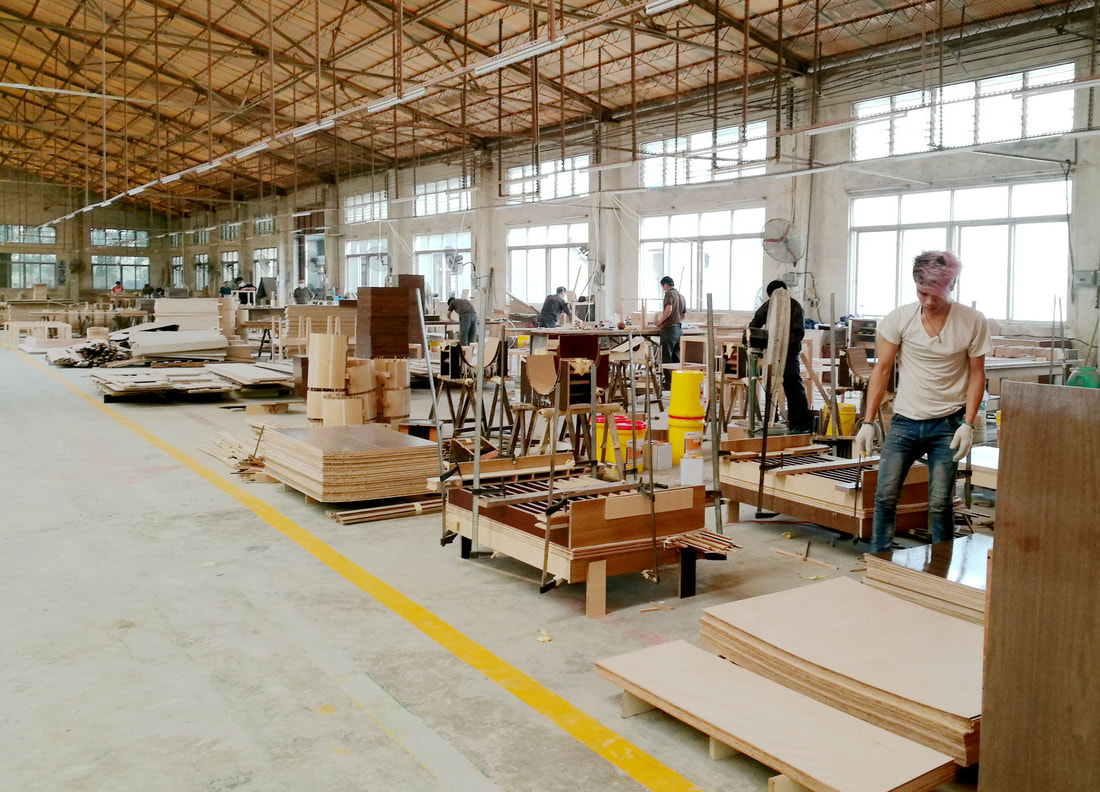
Most quality problems start with the choice of supplier. Before placing an order, especially a first one, you need to know who you are dealing with and whether the factory can actually deliver: that is the role of quality assurance, which complements the control of each order (see quality assurance vs quality control).
A first check is free and can be done from your desk, in China’s public registers: company licence, court records, product alerts and location. Our guide how to verify a Chinese supplier walks you through them, and the one on the Canton Fair applies them to exhibitors you meet at the show. It does not replace a visit to the factory.
A desk check of the company: business licences and declared activity, shareholders, lawsuits and reputation issues in official local databases, and a short interview in Chinese to check the facts. It reveals whether you are dealing with a real manufacturer or a trading company, and who the decision maker is. Supplier due diligence.
A lighter on-site visit, well suited before a one-off order, to check that the factory has the capacity to meet your requirements. Initial factory evaluation.
The full factory audit, recommended for a long-term relationship, based on ISO 9000 principles: factory profile and licences, workforce and QC staff, production lines and equipment, clients and experience, quality management system (purchasing, design control, storage, incoming inspection, in-process control, testing, continual improvement), product and process control, and a corrective actions plan. Factory audit.
An audit of working conditions based on the SA 8000 standard: no child labour, working hours, wages, health and safety. It protects your brand and supports your ethical sourcing commitments. Social audit.
From a basic evaluation to a full ISO 14001 management system audit: environmental policy and permits, energy, water, chemicals, waste and gas emissions, with a corrective actions plan and CSR consulting. Environmental audit.
An inspection checks the product against your specification, but only a laboratory can prove compliance with European regulations: EN 71 for toys, EN standards for childcare articles and furniture, REACH and phthalate limits for all products.
An on-site inspection checks the product against your specifications. It cannot prove that the product complies with a regulation: compliance can only be verified in a laboratory equipped for the tests. For the European market that means, depending on the product:
LPI is part of the Laboratoires Pourquery group. Its affiliated laboratories in Asia (LPHK, Hong Kong) and in Europe (Laboratoires Pourquery) are notified by the European Union for a wide range of standards and have recognised expertise in toys, childcare articles, furniture, sports equipment and electrical appliances. We combine both worlds: the inspector picks the samples in the factory, the lab tests them. Lab testing. Beware of CE logos with squeezed letters: see our guide CE marking or “China Export”.
For projects that go beyond one-off inspections, LPI becomes your team on the ground: feasibility study, supplier selection, supply chain coordination and a dedicated supplier quality manager, with a project manager who speaks your language.

Some projects need more than one-off inspections. LPI can act as your team on the ground:
Each customer works with a dedicated project manager who speaks your language and knows the local context. Project management.
LPI inspects six product families with specialised inspectors: toys and juvenile products, furniture, household goods, electrical and electronic products, industrial and automotive parts, and sports equipment. Only food and chemicals are excluded.
Every product family has its own risks and standards. Our inspectors are specialised by product type:
We inspect all kinds of finished products, including gifts, garments and bags. The only productions we do not inspect are food and chemicals.
LPI works in China, Hong Kong and Taiwan, Southeast Asia (Vietnam, Cambodia, Thailand, Malaysia, Indonesia) and South Asia (India, Bangladesh, Sri Lanka), can reach your supplier within 48 hours and charges the same all-inclusive rate across Asia.
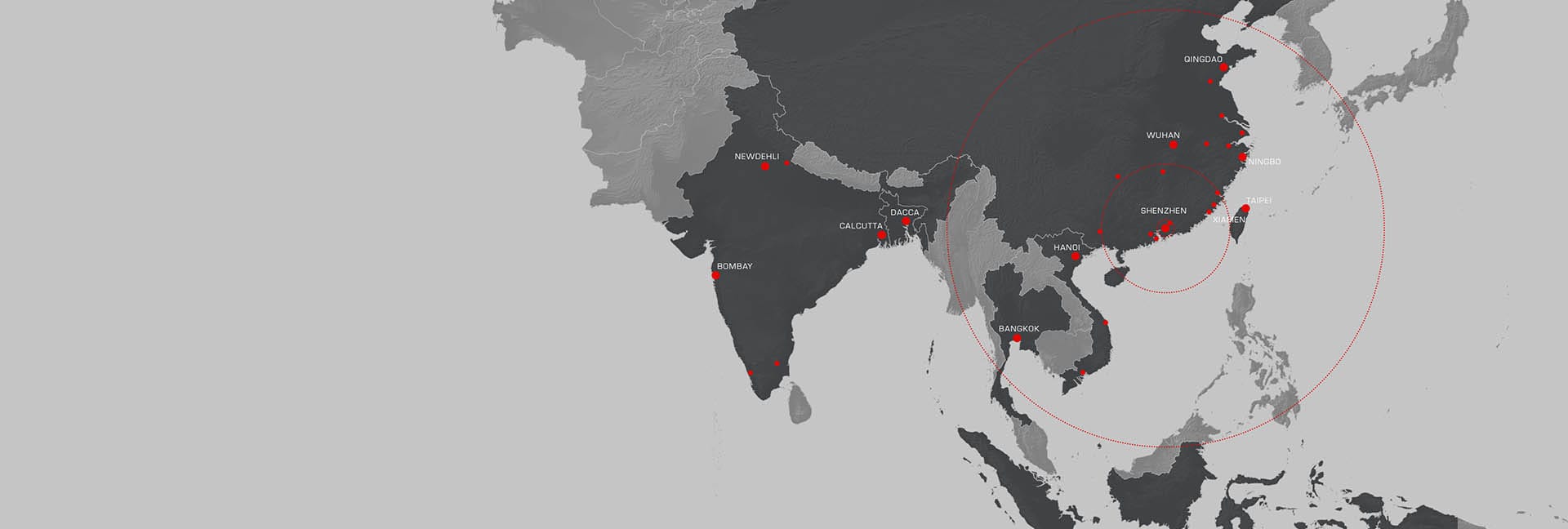
Our inspectors and auditors cover China, Hong Kong and Taiwan, Southeast Asia (Vietnam, Cambodia, Thailand, Malaysia, Indonesia) and South Asia (India, Bangladesh, Sri Lanka). We can be at your supplier’s factory within 48 hours, and we work on all-in pricing everywhere in Asia, so your budget does not depend on where the factory is: see our inspection prices per inspector-day.
Our clients mainly come from Europe and the United States. The team speaks English, French, Chinese, Spanish and Italian: you talk to us in your language, we talk to the factory in theirs.
An LPI inspection costs from US$250 per inspector-day, excluding tax, with travel anywhere in Asia and an illustrated report within 24 hours included. The number of days depends on quantity, AQL level and number of references, and is stated in the quotation before anything is booked.
The same day rate applies to initial production checks, during production inspections, pre-shipment inspections and container loading checks, everywhere in Asia. Factory audits, lab testing and project management are quoted case by case.
What is included, what changes the quote, a worked example and cancellation terms: see our inspection pricing page. To estimate the sample size, and therefore the time spent at the factory, use the AQL calculator.
Book in six steps: describe your order, send your requirements, let LPI schedule with the factory (48 hours minimum, the earlier the better), receive the illustrated report within 24 hours, then decide whether to ship, rework, sort or re-inspect.
To prevent bribery, inspectors never take decisions on the production, the factory manager signs a disclaimer on our anti-corruption policy at every inspection, inspectors rotate between factories and are paid above the market average.
Three practical PDF documents to prepare your inspections, print and keep next to your purchase orders.
The points to prepare and check before you pay the balance: quantities, packing, workmanship, measurements and tests.
Download the PDFSample size and accept / reject numbers for every lot size, single sampling, normal inspection. Ready to print.
Download the PDFThe year’s alerts in figures: product categories, hazards, countries of origin, and what an inspection checks.
Download the PDFFounded in 2012, LPI Quality joined the Laboratoires Pourquery group in 2016, which adds laboratory testing to our inspections and audits. Here is what our clients say.
We have been working with LPI for over 2 years now and we are impressed by their professionalism and quality of the inspection reports. The way our requirements are handled and the level of attention we get helps us a lot in our business. I won't change QC partner at any price.
Buying from suppliers that are at a very far distance has often been a source of stress and anxiety. Since we work with LPI we buy with much more confidence. Their expertise is also adding an undeniable value to our company and a key to our success.
We use LPI to inspect our hand sanitizing billboards, and then send them across the 50 states of USA. Our products have been used by 100 million + people in America, thanks to their effort. Their expertise in hardware inspecting is exceptional - not only the checkpoints we specified but also things we didn't notice. We highly recommend
It is the set of checks an importer organises to make sure products made in China match the specifications and the regulations of the destination market: supplier audits before ordering, inspections during and after production, lab tests and loading supervision. It is usually carried out by an independent third party such as LPI Quality.
They answer different questions. An audit assesses the supplier: is it a real manufacturer, does it have the equipment, the quality system and the working conditions you need? An inspection assesses one order. With a new supplier, start with an initial factory evaluation or a due diligence before paying the deposit, then inspect each order. A good audit does not guarantee a good batch, and a good batch says nothing about what the factory can deliver over time.
Yes. Our planning team fixes the date with the factory: a pre-shipment inspection needs finished, packed goods, and an inspector who arrives too early has nothing to check. What keeps the inspection independent is not surprise but the inspector’s rules: they never decide on the production and they rotate between factories. Also write the AQL and third-party inspection into your purchase order, so the supplier knows from the start that a rejected batch will be reworked at its own cost.
With a new supplier or a new product, yes: it is the only way to build a track record. Once several consecutive orders have passed, you can space out inspections or keep only the pre-shipment inspection. After a failed inspection, do the opposite: add a during production inspection or production monitoring on the next order until the results are stable again.
The report shows exactly which defects were found and how many. If the AQL agreed in your purchase order is not met, you can ask the supplier to rework or sort the goods and to pay for a re-inspection before shipment. Our guide failed inspection: what to do details the options.
We inspect all kinds of finished products. The only productions we do not inspect are food and chemicals.
Tell us about your product and your supplier: we answer within one working day with an inspection plan and a quote.